
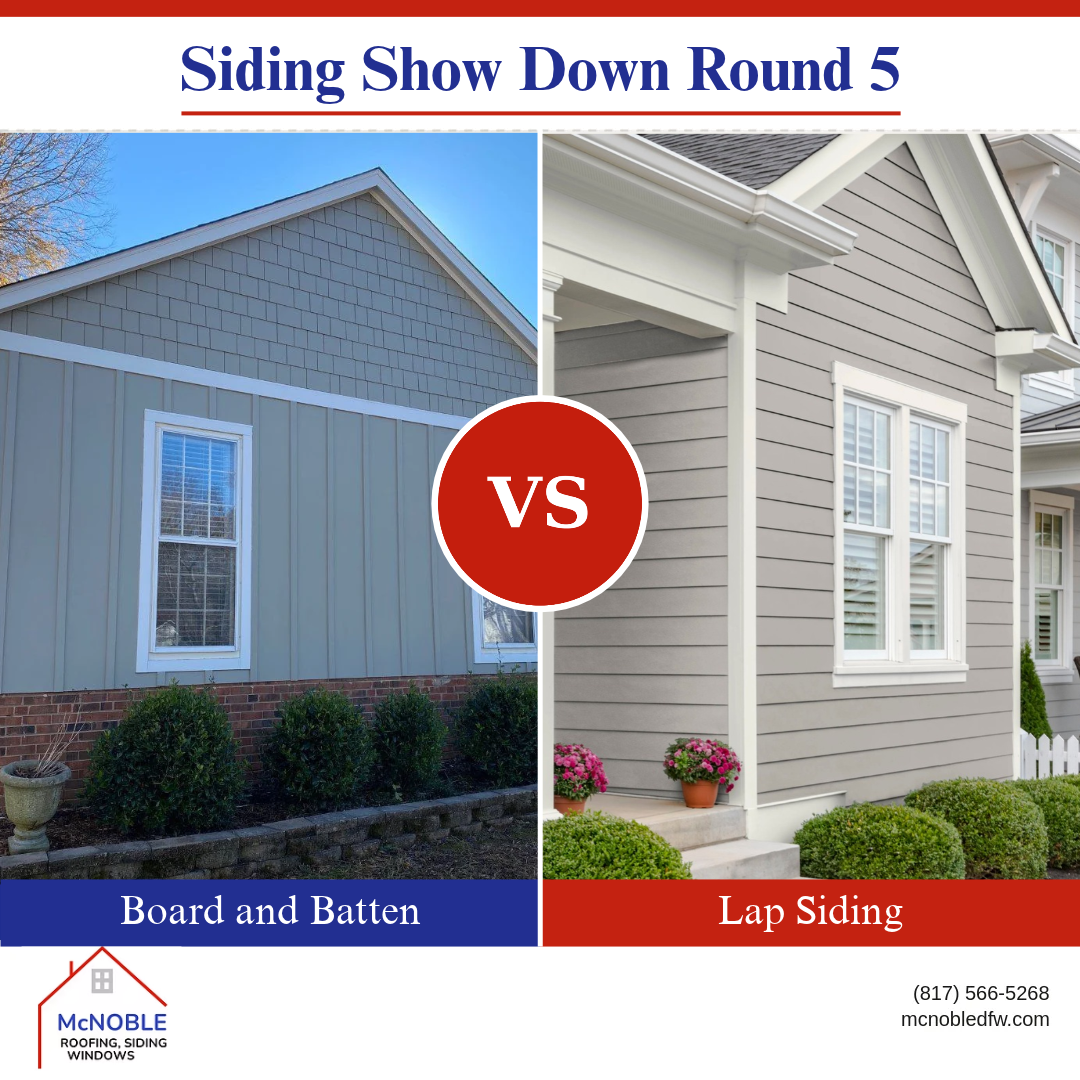
This month's Siding Showdown is a little different. Board and batten and lap siding are not two materials. They are two ways of hanging siding, and you can get both in vinyl, fiber cement, and engineered wood. The difference is direction and seams. Lap siding runs horizontally, with each board overlapping the one below it. Board and batten runs vertically, with narrow strips called battens covering the joints between wide boards or panels. Either one works in North Texas, and the quality of the installation matters more than the profile.
What Is Each Style, Exactly?
James Hardie's siding terminology guide defines the pieces simply. Lap siding is horizontal, and each plank overlaps the one below it, with the visible portion called the reveal. Panel siding is long vertical boards in various styles and textures. Battens are vertical trim strips placed at regular intervals on panel siding to cover the joints. Board and batten is the look you get when those vertical panels and battens work together.
LP Building Solutions describes three ways to get that look with its engineered wood:
Panel siding. Wide sheets, four feet wide in lengths that start at eight feet. They cover more wall per piece, and battens can be spaced at different intervals.
Vertical siding. Boards 16 inches wide and 16 feet long, which means fewer joints on a tall wall. Battens must be at least 16 inches apart to cover the seams.
Lap siding hung vertically. Boards from 6 to 12 inches wide, with battens at every seam at a minimum.
How Do They Handle Water?
On a lap wall, the overlap itself sheds water, and the detail that matters is how the joints between boards are flashed. James Hardie's installation tips recommend 6-inch-wide flashing that overlaps the course below by 1 inch.
On a vertical wall, water runs straight down the face, so the bottom edge and the joints do more of the work. For vinyl, the Polymeric Exteriors Products Association (PEPA, formerly the Vinyl Siding Institute) says in its vertical siding instructions to use a J-channel at the base with weep holes at least 3/16 of an inch across, spaced no more than 24 inches apart. On multi-story walls, it adds head flashing and a second J-channel with weep holes so water can get out. LP notes that vertical siding must be installed over a wall with a water-resistive barrier and should not bridge floors.
In both cases, what is behind the siding matters as much as the siding itself.
How Does Heat Change the Picture?
North Texas gets about 20 days a year at or above 100 degrees, according to the National Weather Service's 1991 to 2020 normals, and vinyl moves with that heat. PEPA's vertical instructions build in the movement: the first fastener sits at the top of the highest full nail slot, allowing 1/4 inch of travel up and 3/8 inch down, and fasteners go no more than 12 inches apart. Vinyl also needs 1/4 inch of clearance at windows and doors, and 3/8 inch when installed below 40 degrees.
Other materials come with their own installation rules. For example, LP calls for at least six inches of clearance from finished grade on its panel siding. Whichever material you choose, follow the manufacturer's instructions for that exact product and profile.
Board and Batten vs. Lap: Side by Side
Lap siding
Direction: Horizontal.
How seams are covered: Each board overlaps the one below it.
Look: Traditional, and it can visually widen a narrow home.
Install effort: Quicker and simpler.
Where water has to be managed: At the overlaps and butt joints.
Typical fit: A wide range of home styles.
Materials in North Texas: Vinyl, fiber cement, and LP SmartSide.
Board and batten
Direction: Vertical.
How seams are covered: Battens cover the joints.
Look: Textured and vertical, and it adds visual height.
Install effort: More precise, with more pieces to set.
Where water has to be managed: At the base, the joints, and floor lines.
Typical fit: Farmhouse and rustic styles, gables, and tall features.
Materials in North Texas: Vinyl, fiber cement, and LP SmartSide.
The comparison of look, install time, and fit draws on Angi's guide to board and batten vs. lap siding, which also says the two styles can be mixed on one home. Angi's page lists no author or date, so treat it as general guidance, not a technical spec.
Which Should You Choose?
A few practical ways to decide:
Choose lap if you want the most familiar look, the widest range of options, and a simpler install.
Choose board and batten if you want strong vertical lines, a more textured wall, or a farmhouse look, and you are working with a contractor who details seams and flashing carefully.
Mix them. A common design move is to use board and batten on a gable or an entry and lap on the rest of the wall, which Angi also suggests.
Cost is worth asking about, but the numbers depend on the material, the profile, and your home, so we would rather give you an estimate in writing than quote a range here. Angi says lap is usually less expensive because the install is simpler, and that material choice is the biggest cost factor.
If you are still choosing a material, our earlier showdown on vinyl vs. LP SmartSide breaks that down.
Frequently Asked Questions
Can you install lap siding vertically? Yes, with some materials. LP says its lap siding can be hung vertically with battens at every seam, and notes it has its own fastening guidelines to follow.
Does board and batten cost more than lap? Usually, according to Angi, because the install is more involved. The material you pick has a larger effect on price than the profile.
Can I use both styles on one house? Yes. Angi notes the two styles can be mixed for a customized exterior, and our example above uses board and batten as an accent.
Is vertical siding harder to keep watertight? It puts more of the water management at the base and joints, which is why details like J-channel weep holes and flashing matter. Done correctly, it performs well.
Does the style change how much upkeep I have? Material has a bigger effect than profile. Our siding maintenance checklist covers what to look at each season.
Ready to Compare Them on Your Home?
The easiest way to decide is to see both profiles in the material you like, next to your trim and roofline. We are happy to walk your home with you and talk through what fits. Visit our siding services page, or contact us or call (817) 566-5268 to schedule a free inspection.
Sources
Angi. "Board and Batten vs. Lap Siding." https://www.angi.com/articles/board-batten-vs-lap-siding.htm
James Hardie. "Siding Terminology 101." https://www.jameshardie.com/blog/siding-terminology-101
James Hardie. "Tips for Installing James Hardie Lap Siding." https://www.jameshardie.com/blog/for-siding-pros/tips-for-installing-james-hardie-lap-siding/
LP Building Solutions. "Vertical vs. Panel Siding: What to Use for Board and Batten Style Siding Installation." https://www.lpcorp.com/blog/best-board-batten-install-panel-vs-vertical-siding
National Weather Service Fort Worth. "1991-2020 Climate Normals." https://www.weather.gov/fwd/1991-2020_normals
Polymeric Exteriors Products Association. "Vertical Vinyl Siding Installation." https://polymericexteriors.org/installation/installation-manual/vertical-siding-installation/