
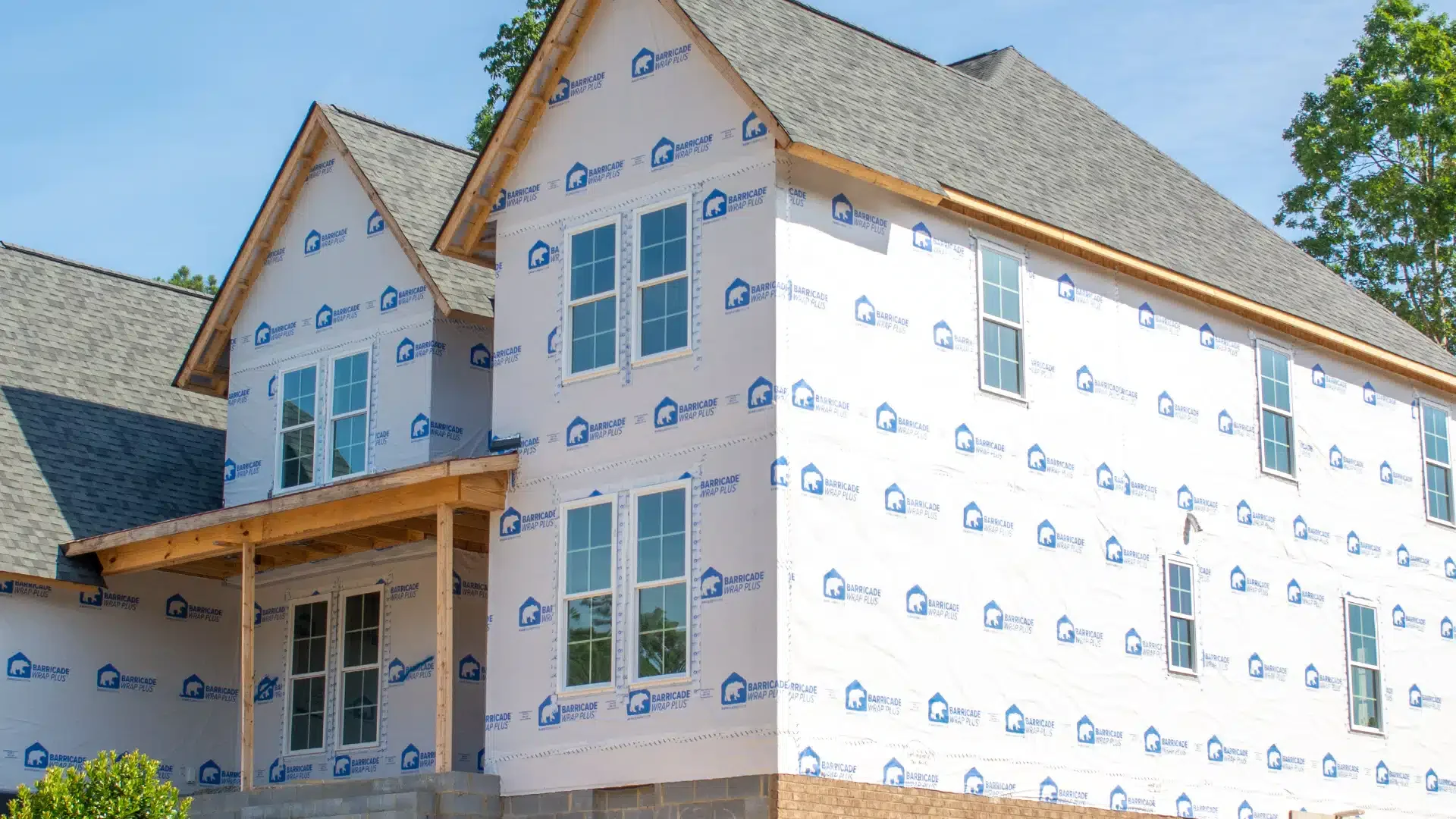
House wrap is the weather barrier that sits between your wall sheathing and your siding. Its job is to stop liquid water that gets past the siding, and some always does, and to let that water drain out instead of soaking into the wall. You cannot see it once the siding is on, which is why the way it is installed, lapped, and flashed matters so much, and why it is one of the best questions to ask before a siding job starts.
What Does House Wrap Actually Do?
Siding is the outer layer, not a waterproof seal. Wind-driven rain, gaps at trim, and small openings let some water behind it. The International Institute of Building Enclosure Consultants (IIBEC) explains that the primary function of a building wrap is to resist liquid water that has migrated through the exterior cladding. In a wall built with a drainage space, it also lets that water drain out and lets the wall dry.
IIBEC adds that building wraps are commonly used as both a water barrier and an air barrier, and that housewraps gained acceptance in the 1980s because they did both jobs, replacing asphalt felt that tore easily, was sensitive to sunlight, and came in narrow rolls with many seams.
Is House Wrap Required?
In general, yes. Fine Homebuilding's summary of the International Residential Code says the code's purpose is to prevent water from accumulating within the wall assembly, and that it does this with a water-resistive barrier behind the siding and a way to drain water that gets past it. The code allows either No. 15 asphalt felt that meets ASTM D226, or another water-resistive barrier approved by the local building official. If an alternative is used, it has to be installed according to the manufacturer's instructions.
Siding makers say the same thing. LP's guidance on vertical siding states that a water-resistive barrier is required, and James Hardie's installation tips tell installers to snap their layout lines on the water-resistive barrier, which treats it as the base layer under the siding. Local codes and the edition your city enforces vary, so ask your contractor which applies.
What Are the Options Behind Your Siding?
Asphalt felt. This is the older option, No. 15 felt meeting ASTM D226. Per the code summary, it is applied horizontally with laps of at least 2 inches, and 6 inches at vertical joints.
Housewrap. These are large synthetic sheets, now the major material. Manufacturers' instructions typically call for 4 to 6 inches of horizontal overlap and 6 to 12 inches of vertical overlap.
Taped or coated sheathing. This is a drainage layer built into the sheathing, such as taped sheathing or a liquid-applied coating. The Pacific Northwest National Laboratory's Building America Solution Center recognizes it as an alternative drainage plane.
Whatever the material, the barrier has to be continuous to the top of the wall and properly terminated at openings and the points where something passes through it.
How Does House Wrap Fail?
Almost every failure is a detail, not the material. Fine Homebuilding lists the most common installation defects as reverse overlaps, insufficient laps, gaps, tears, and staples pulling through in wind. IIBEC adds a few more:
Fastener holes. Wraps that are mechanically fastened have holes at every fastener, so installers must take care that the penetrations do not leak.
Sun exposure. A wrap that is not UV-stabilized degrades if it is left exposed for a long time before the siding goes on.
Seams that do not bond. Some low-energy surfaces make tapes and adhesives hard to bond, so seams and overlaps can fail to hold.
Then there are windows. The Building America Solution Center says flashing must be integrated with the drainage plane, whether it is housewrap, taped sheathing, or a coating, so that water is directed out of the wall and not into it. Our post on replacing windows and siding in the right order covers that seam in detail.
Why Can't You Just Check It Later?
Because it is hidden. Once the siding goes on, the barrier is covered, and a leak can run for years before anyone notices. Fine Homebuilding's author says water that gets behind a failed barrier can lead to mold and rot, and that a leak can go on for a long time before anyone sees a sign. That is why the Building America Solution Center says to inspect window and door flashing before siding is installed.
If your home is older, the barrier behind your siding may be felt, a housewrap, or something else, and you generally will not know until a section of siding is opened. That is one reason a full re-side is a good moment to look at what is behind the wall.
Questions to Ask Your Contractor
What water-resistive barrier will you use, and whose installation instructions will you follow?
How will the seams be lapped and taped, and how are the fastener holes handled?
How will the barrier and window flashing be integrated?
How long will the barrier stay exposed before siding goes on, and what protects it?
Can I see photos of the barrier and flashing before the siding covers them?
If the old barrier is damaged, what happens next?
Our guide to choosing a siding contractor has more questions worth asking before you sign.
Frequently Asked Questions
Is house wrap the same as a vapor barrier? No. A water-resistive barrier is about liquid water. IIBEC treats the air barrier as a separate function, even though one product can do both. Whether your wall needs a separate vapor control layer is a different question for your contractor.
Is house wrap the same as tar paper? They are two options for the same job. The code lists No. 15 asphalt felt as one of the allowed materials, and IIBEC says synthetic housewraps replaced felt as the major material.
Can house wrap stay exposed during a job? Only for a limited time. IIBEC notes that wraps that are not UV-stabilized degrade if left exposed for long, so each product has its own limit. Ask your contractor to follow the manufacturer's instructions.
Does every siding type need house wrap? In general, yes, according to the code summary, and both LP and James Hardie describe a water-resistive barrier as part of the wall. Follow the instructions for the specific siding and barrier you choose.
How do I know if my wall has a problem behind the siding? You often cannot tell from the outside. Staining or soft trim near windows are worth a close look, and a professional inspection can open or check key spots.
Planning a Siding Project for the New Year?
If you are thinking about new siding in 2027, ask about what goes behind it first. We are happy to explain our approach, show you how the barrier and flashing are handled on your home, and put the details in writing. Visit our siding services page, or contact us or call (817) 566-5268 to schedule a free inspection.
Sources
Fine Homebuilding. Mike Guertin. "What's the Building Code for Housewrap Installation?" April 23, 2018. https://www.finehomebuilding.com/2018/04/23/whats-building-code-housewrap-installation
International Institute of Building Enclosure Consultants (IIBEC). "Let's Wrap About Building Wraps." https://iibec.org/publication-post/lets-rap-about-building-wraps/
James Hardie. "Tips for Installing James Hardie Lap Siding." https://www.jameshardie.com/blog/for-siding-pros/tips-for-installing-james-hardie-lap-siding/
LP Building Solutions. "Vertical vs. Panel Siding: What to Use for Board and Batten Style Siding Installation." https://www.lpcorp.com/blog/best-board-batten-install-panel-vs-vertical-siding
Pacific Northwest National Laboratory, Building America Solution Center. "Fully Flashed Window and Door Openings." https://basc.pnnl.gov/resource-guides/fully-flashed-window-and-door-openings