
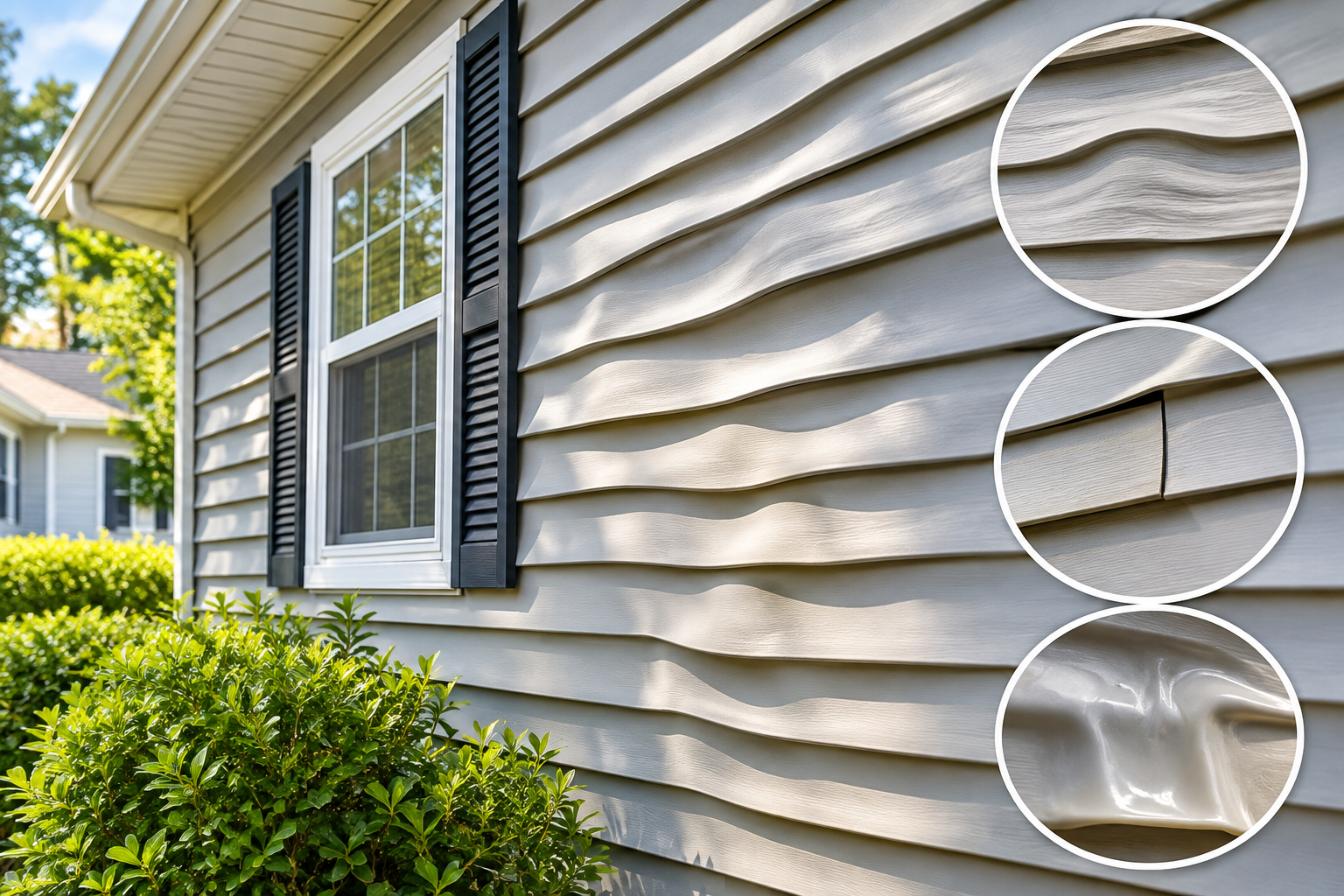
Vinyl siding usually warps for one of two reasons: it was installed without enough room to move, or concentrated heat softened it, often from sunlight bouncing off a window. Waves that repeat across a wall tend to point to how the panels were fastened. A distorted or melted patch in one spot tends to point to heat. You can often narrow it down from the ground, and the fix depends on which one you have.
Why Does Vinyl Siding Move at All?
Vinyl changes size with temperature, and the amount is bigger than most people expect. The Polymeric Exteriors Products Association (PEPA), the trade group formerly known as the Vinyl Siding Institute, says vinyl siding can expand and contract half an inch or more over a 12 foot 6 inch length.
To allow for that, PEPA's installation guidance calls for centering fasteners in the nailing slots, driving them straight, and leaving about 1/32 of an inch (roughly the thickness of a dime) between the nail head and the panel. It also calls for at least 1/4 inch of clearance at openings and stops, and 3/8 inch when installing below 40 degrees. The goal is simple: panels should slide freely from side to side.
North Texas gives vinyl a real workout. The National Weather Service's 1991 to 2020 climate normals list about 20 days per year at or above 100 degrees for Dallas/Fort Worth, so a panel that has no room to grow has plenty of chances to buckle.
Cause 1: Panels That Cannot Move
If panels are fastened too tightly, or the ends are jammed against trim without clearance, the expansion has nowhere to go. The panel ripples instead. This is usually an installation problem, not a product defect, and it tends to show up as waves along the panels once the weather turns hot.
A few signs point this direction:
The waves repeat at regular intervals along a run of siding.
The problem appears across a large area, not one spot.
It showed up in the first warm months after the siding went on.
You cannot see how the panels were fastened from the outside, so this is a case where a professional look is worth it.
Cause 2: Sunlight Reflected Off a Window
The second cause surprises many homeowners. A Massachusetts Department of Public Safety advisory explains that glass in double-paned windows can slightly flex inward, and a slightly concave pane can focus reflected sunlight the way a magnifying glass does. The advisory says heat from that reflected light has been measured above 200 degrees Fahrenheit. It also says the Vinyl Siding Institute reports that temperatures starting around 160 to 165 degrees can soften normal grades of vinyl, with darker colors softening sooner than lighter ones.
PEPA's own page on solar reflection says the effect is not caused by vinyl siding, and ties it to newer low-e windows on nearby structures, which means the window doing the damage may be on your neighbor's house, not yours. PEPA's 2026 document on concentrated sunlight adds that most distortion cases involve a partially collapsed insulating glass unit that bows inward and creates a concave reflective surface, and that siding color appears to be at most a secondary factor.
Two details matter in December. The Massachusetts advisory says low sun angles, such as in late fall, winter, and early spring, make the effect more likely. And PEPA says reflected sunlight can harm other things in its path as well, listing painted surfaces and cedar shingles among reported cases, so switching materials does not make a house immune.
How Can You Tell Which Cause You Have?
Waves or ripples that repeat along panels across a wall. The likely cause is panels fastened too tight or without room to move. Check whether panels slide side to side by hand, and whether nail heads sit tight against the panel.
A warped or melted patch in one area, often lined up with a window on your house or a neighbor's. The likely cause is concentrated reflected sunlight. Check whether a straight line runs from a window to the damage, and what time of day and year it appears.
Buckling or gaps at the ends of panels near corners, trim, or window casings. The likely cause is not enough end clearance. Check whether the panel ends touch the trim, since PEPA calls for 1/4 inch at openings and 3/8 inch below 40 degrees.
Cracks or holes after a storm. This is impact damage, not warping. See our post on hail and storm damage to siding.
What Actually Fixes Warped Siding?
For an installation problem, the fix is to correct how the panels are held, not to add more nails. Fastening harder works against how vinyl is designed to move. A contractor typically needs to release or replace the affected panels and refasten them with the correct clearance.
For reflected heat, replacing the siding alone is a temporary answer. The Massachusetts advisory says replacing damaged siding by itself is not permanent because the conditions can recur. The more lasting options are about the light itself:
Block the path of the sunlight with trees, shrubs, or sunshades above windows, as PEPA suggests, or with an awning, as the advisory suggests.
Add a window screen, which PEPA says may reduce the reflected energy.
Talk to the window manufacturer. PEPA notes that replacing windows, on your house or a neighbor's, can change the risk. The advisory also lists clear glass, thicker glass, and heat-resistant siding as options, with tradeoffs in code requirements and cost.
The advisory is from 2010 and is informational only, so treat it as background and check current product guidance before choosing a fix.
Frequently Asked Questions
Is warped siding covered by my warranty? Usually not if the cause is reflected sunlight. PEPA says siding warranties generally do not cover damage from unnaturally concentrated sunlight, and advises contacting the siding manufacturer for specifics. If the cause is installation, the question is for your installer.
Can I fix wavy siding by adding more nails? Usually no. Vinyl is meant to slide on its fasteners, so pinning it tighter works against that. Have a professional check the panels first.
Does dark siding warp more than light siding? Darker colors absorb more heat and soften sooner, according to the Massachusetts advisory. PEPA's 2026 document says color appears to be at most a secondary factor in reflected sunlight cases. In short, color can matter, but it is not the main driver.
Can my neighbor's windows damage my siding? Yes. PEPA ties the problem to low-e windows on nearby structures, and says replacing windows on either house can change the risk.
How hot does vinyl have to get to soften? The advisory cites 160 to 165 degrees to begin softening normal grades, and reports reflected heat above 200 degrees in documented cases.
Not Sure What You Are Looking At?
If a wall has waves, a melted patch, or gaps you cannot explain, we are happy to walk the exterior with you, look at how the panels are held, and tell you plainly what is going on. Start with our siding services page, compare materials in our vinyl vs. LP SmartSide showdown, or contact us or call (817) 566-5268 to schedule a free inspection.
Sources
Commonwealth of Massachusetts, Department of Public Safety. "Vinyl Siding Distortion Advisory: The Effect of Reflected Sunlight from Low-e and other Double Paned Window Glass on Vinyl Siding." August 10, 2010. https://www.mass.gov/doc/vinyl-siding-advisory/download
National Weather Service Fort Worth. "1991-2020 Climate Normals." https://www.weather.gov/fwd/1991-2020_normals
Polymeric Exteriors Products Association. "Effect of Concentrated Sunlight on Polymeric Siding." 2026. https://polymericexteriors.org/wp-content/uploads/2026/06/Effect_Of_Concentrated_Sunlight_Polymeric_Siding2026.pdf
Polymeric Exteriors Products Association. "Solar Reflection: Get the Facts." https://polymericexteriors.org/vsi-resources/solar-reflection/
Polymeric Exteriors Products Association. "Vinyl Siding Installation Tips and Tricks." https://polymericexteriors.org/installation/tips-and-tricks/